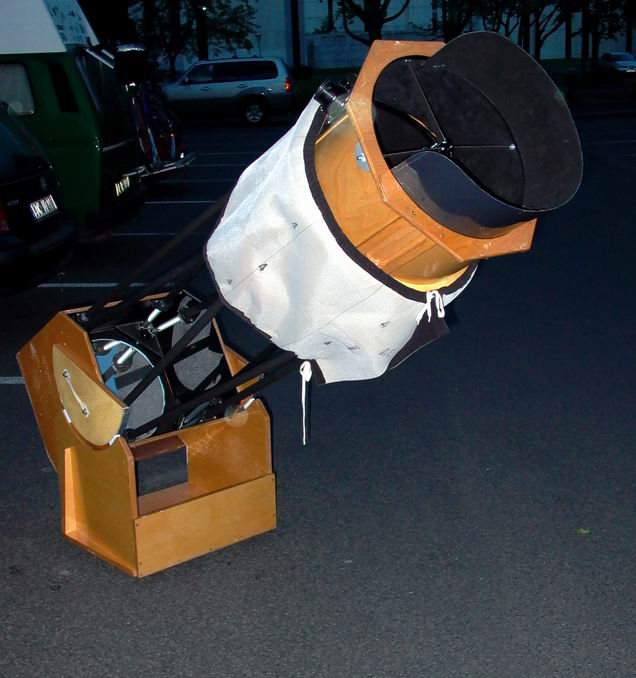
Observing the faint fuzzies of the Deep Sky requires a dark sky and a telescope with a big aperture. When I became addicted to hunting down faint fuzzies I decided to search a big telescope. As a student I had a tight budget, so I decided to build the scope myself. I started in 1997.
I don't consider myself to be a "Amateur telescope maker". My main interest in astronomy is observing, not making of equipment. But right after completing the 20cm Dobson, I found myself making the next telescope!
Again, I chosed the Dobson-design with a truss-road tube. I don't like to call this telescope a Dobson because I feel it contradicts the original idea of John Dobson. It comprises a very good optics and some special parts that are really not Dobsonesque. To avoid the trouble that I had with the center of mass of the 20cm Dobson I wrote a little program. This program calculated the center of mass - in realtime! Whenever I finished a part of the telescope, I could check the position of the center of mass. At the end, the position was just a few millimeters off!
The telescope comprises some special features. For example the main mirror cell. The mirror is centered on
9 points (that's okay according to some FEM calculations). A ring of roofmate fixes the mirror in the radial
direction. The rods of the tube have balls on both of their ends. They are fixed in pairs which allows for
setting up the telescope without adding parts to the telescope.
Against all wisdom and tradition I decided to disobey a rule: In "normal" scope of that type the hat fits into
the mirror cell. The drawback of that is that the mirror box becomes large - or better: extra large. I had
a small car, so I built it another way. Now the scope can be handled quite easily in small places. A great thing!
| Type: | Newton |
| Optics: | 40cm f/5, Galaxy "Premium" |
| Mount: | Alt-Az, sliding bearing |
(c) by Frank Leiter